My wife is a big fan of a St. Germaine and champagne cocktail. Recipes vary, ours is (dry) champagne, St. Germaine’s elderflower liquer, lemon (I’ve seen some use limoncello, but ick, give me real lemon anytime), and a lemon twist. Our local favorite cocktail houses serve it in a flute or wide (martini) cocktail glass.
But when we want a bubbly lift without all the alcohol, we might make an elderflower lemonade cocktail:
- Fill a tall glass 2/3rds with ice.
- Fill glass 3/4ths with plain sparkling water.
- Use a zester or peeler to make a long lemon zest twist, then cut the lemon in half.
- Cover the lemon with a cloth before squeezing or squeeze through a screen to catch seeds, then squeeze entire lemon in to glass.
- Add 1+ ounce St. Germain’s elderflower liquer, or to taste. You are looking for the point where the sweet just cuts the tart enough to be drinkable, but it still makes you want to pucker a bit – tart, not too sweet.
- Rub twist around glass rim, squeeze to bruise the skin to release more oils, and top drink.
Days must be getting warmer, eh?
(If you like this recipe, try out the next evolution, the Mexicano, a Mexican-style mocha.)
When I first read about the idea of putting cardamom in coffee, I was intrigued. I’ve always appreciated the effects of fresh, green cardamom pods in cooking, and the idea of an old Arabic tradition for welcoming a guest with hot cardamom coffee was too cool to not figure out.
But all the recipes I found didn’t treat the coffee beans, cardamom seeds, or resulting brew in a way I liked. I think many relied upon an older way of making coffee, where you simmer chunky-ground beans and seeds in a pot, then strain and sweeten. I’m more of a modern, fresh-ground coffee type of person. So I built a recipe that worked for me. This is the recipe for a single cup, increase proportions for more brew, adjusting the quantity of cardamom seeds to taste.
- In your coffee grinder put your measure of roasted coffee beans, quantity to taste.
- Take one to three green cardamom pods and crush them on the counter. Separate the seeds from the green skin, put the seeds in the grinder with your beans. (I found three pods works for me, some people I’ve gave this to prefer two pods, use one pod if you want a lighter taste or just as starting place to work up from. For me, four pods per cup was too much, but I can see people who would prefer more pods.)
- Grind the coffee beans and cardamom seeds together until the coffee is the grind level you want to work with.
- Brew the coffee the way you prefer.
- The resulting brew may be more bitter than you like. As I usually use a touch of cream or milk to lighten and sweeten my coffee, I also use a touch of honey in this cardamom coffee.
Look, there are a million ways to brew a cup of coffee. (If not a literal million, it often feels like it.)
This tip is for when you are doing any kind of brewing where you manually add hot water to the grinds, such as for pouring through a paper filter. It gives the grounds a chance to bloom in the water, surrounding each coffee granule with near-boiling water to extract the maximum bean juices.
- Put the ground coffee in to a clean glass jar or cup with at least 8 oz of volume.
- Pour boiling water in to the coffee cup you will use for making coffee. This heats the cup and cools the water slightly to brewing temperature.
- Pour 4+ oz slightly-cooled water over the grounds in the jar/cup, then stir until fully moistened.
- Wait 15 to 30 seconds, but not much longer than 1 minute so it doesn’t cool down too much.
- Pour the water and grounds over your filter, finish brewing as usual.
You can use this method to prepare coffee for a large coffee maker.
At one cafe I go to, I noticed they do a similar thing. They put the grounds in a French press, let it sit, then press it, and pour the resulting brew through a paper or gold filter. Functionally the same was what I do at home, with more to clean-up.
I asked my wife if she wanted a classic red tomato sweet-tangy sauce for barbecue, and of course the answer was yes. Sure, a Hoisin sauce-style would go well, too, but some things just scream “BBQ SAUCE!”
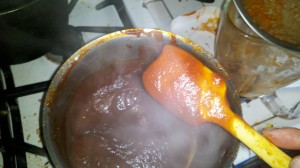
Rather than having a secret family recipe, I prefer to create one from scratch each time and savor the process and result. I suppose one day I’ll cook up something with bourbon and bourbon vanillla, but for now today’s sauce went something like this. All ingredients used are organic and/or from our own urban farm.
- Filled a two-quart pot more than half-way with frozen cherry tomatoes – from last Summer’s garden. I poured in about two tablespoons of white vinegar, then put a lid on and ran them on medium heat until they were heated through. Once soft, I mashed them down with a potato masher.
- Chopped and added to the tomatoes: one small mild green pepper, one-quarter of a big red bell pepper, and one medium yellow onion. I put the lid back on and simmered it until the veggies were all cooked through.
- Put the whole mess in to the blender, put on a lid with the center hole open and covered that loosely with a towel. There will be a burst up of hot blending matter when the blender starts, and it is much less explosive when there is an easy vent (the towel) for the heated air to escape.
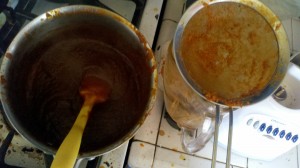
- Blended until smooth, knowing the skins and seeds won’t really blend so don’t bother. Ran this all through a fine-mesh sieve, using a silicone spatula to rub the sauce back, forth, around in circles until all the juices ran through the sieve. Scrapped the bottom of the side, and fed the tomato skins and seeds to the chickens.
- This sauce base now needs flavor balancing with a focus on sweet-tangy. I put in more salt to taste (less than a teaspoon, we want this sauce to go with salty/savory foods), a few grinds of black pepper, a few shakes of hot sauce, a tablespoon of sweet red paprika (basically roasted and ground sweet red peppers), then the tart and sweet: just less than 1/4 cup of coconut sugar crystals (works like brown sugar), 1/4 cup honey, and just a bit more than 1/4 cup of apple cider vinegar with a few shakes of white vinegar and blood-orange balsamic vinegar. Adjust the sweet-tangy to taste and preference; I ended up shaking in a bit more red wine vinegar, too.
- Put a screen lid on top of the sauce and reduced it to almost half of the original volume (very messy). Rebalanced flavors, and it’s done.
This blog was offline for a few weeks, as well as some other websites of mine, after they all go infected with a PHP hack that inserted into each file code that was disguised in base64. It most likely vectored-in via an unpatched exploit in one of the sites. It all started somewhat small with just two sites, but I wasn’t able to clean it up in time, and it ended up infecting all of my sites.
In the end, I did what I should have done in the first place – turned over the de-cracking to DreamHost’s team. They cleaned out all the evil, and I’ve been busy changing passwords, reinstalling from fresh code, and so forth.

